From KOSPI 5000 to 9000 in a Year and a Half: Breaking Down Korea's 2026 Semiconductor Supercycle Rally
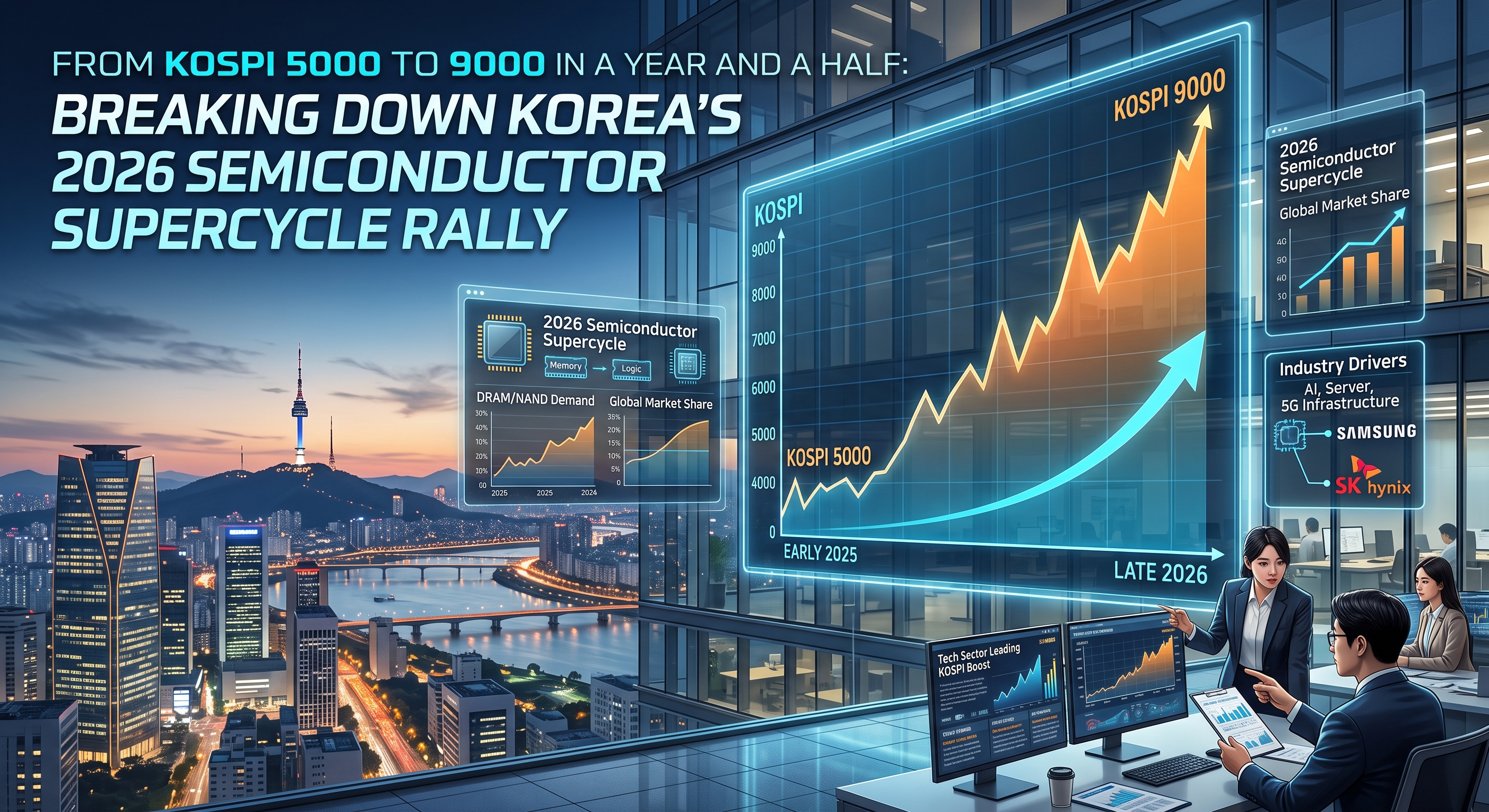
Back in early 2025, KOSPI 5000 was mostly wishful thinking. Then, on January 22, 2026, Korea's benchmark index broke 5000 intraday for the first time ever. By January 27, it had closed above that level too. Five months later, on June 18, it blew past 9000. A move like that, in that short a window, is rare even by KOSPI's own volatile standards.
This piece walks through where the rally actually came from, what the numbers say about it, and what risks are worth keeping an eye on right now — based on verifiable market data rather than hype.
From 3000 to 9000: The Pace Completely Changed
It took KOSPI four years and nine months to climb from 3000 to 4000. Getting from 4000 to 5000 took just three months. And after 5000, things sped up even more.
Here's the rough timeline of KOSPI's historic run:
- January 2, 2025 (2,398.94): KOSPI would go on to gain roughly 71–73% over the course of 2025, marking its best annual performance on record.
- December 22, 2025 (4,105.93): Closed up 71.16% for the year, solidifying the baseline for the 2026 surge.
- January 22, 2026: Broke the psychological barrier of 5,000 intraday for the first time in history.
- January 27, 2026: Successfully closed above 5,000, shifting market paradigms.
- February 2, 2026 (4,949.67): Concerns tied to a U.S. Federal Reserve chair nomination triggered risk-off selling, causing KOSPI to briefly slip back below 5,000 intraday. This highlighted that the run wasn't a straight line.
- May 6, 2026 (7,384.56): A massive semiconductor-led rally sent the index up 6.45% in a single day, recording the second-largest single-day point gain in KOSPI history.
- June 18, 2026 (9,063.84): Crossed the historic 9,000 milestone for the first time.
Narrowing the window to just the first half of 2026, KOSPI went from 4,309.63 on January 2 to 8,476.48 by June 30 — nearly doubling in six months. Total market capitalization grew from roughly 3,558.7 trillion won to 6,929.5 trillion won over the same stretch, an increase of about 3,371 trillion won.
Is This Really All Down to Semiconductors?
Short answer: yes. Overwhelmingly so. Between January 2 and June 30, 2026, about 85% of KOSPI's total market-cap increase came from just four major stocks: Samsung Electronics, SK Hynix, Samsung Electronics preferred shares, and SK Square (the holding company owning SK Hynix's stake).
| Market Metric | January 2, 2026 | June 30, 2026 |
|---|---|---|
| Total KOSPI Market Cap | Approx. 3,558.7 Trillion KRW | Approx. 6,929.5 Trillion KRW |
| Top 4 Semi-Related Stocks Weight | 39% of Total Market Cap | 61% of Total Market Cap |
Look at individual stocks and the picture gets even sharper. From early June 2025 through May 28, 2026, Samsung Electronics and SK Hynix shares rose roughly 436% and 1,000%, respectively. On May 6, 2026 alone — the day of that historic single-day surge — only 200 KOSPI-listed stocks rose while 679 fell, yet the index still jumped 6.45%, driven almost entirely by Samsung Electronics (+14.41%) and SK Hynix (+10.64%). Most of the market didn't move. The index did anyway.
The reason behind this concentration traces back to the explosive growth in AI data center demand that took off in the second half of 2025. As Nvidia and other major U.S. tech companies poured money into AI infrastructure, HBM (high-bandwidth memory) production ramped up, squeezing supply of general-purpose DRAM and NAND flash and sending prices sharply higher. Samsung Electronics and SK Hynix happen to be the world's top two DRAM makers and also KOSPI's two largest companies by market cap — which is exactly why a memory-chip price spike translated so directly into an index-wide rally.
What the Earnings Numbers Actually Show
Part of why this rally is hard to write off as pure liquidity-driven froth is that earnings have genuinely kept pace. KOSPI-listed companies posted an estimated combined operating profit of around 330 trillion won in 2025. For 2026, that figure is projected to comfortably clear 500 trillion won — a 60–70% jump. Samsung Electronics and SK Hynix alone have seen their 2026 operating profit estimates revised up three- to four-fold from where forecasts stood in late 2025. The two companies' combined 2025 operating profit was in the 80-trillion-won range; 2026 estimates put that figure at nearly double.
On valuation, one detail stands out: despite how far KOSPI has run in such a short time, its 12-month forward P/E ratio is still sitting around 10x. Share prices climbed fast, but earnings forecasts climbed right alongside them — which is why some analysts argue the valuation picture isn't as stretched as the headline index level might suggest.
Policy support played a role too. A round of Commercial Act reforms aimed at improving transparency around treasury stock handling and strengthening shareholder rights, the government's broader "value-up" push, and ongoing corporate governance reforms meant to close the so-called "Korea discount" all converged around the same period — helping pull money out of bank deposits and real estate and into equities.
Why This Isn't a Reason to Get Fully Comfortable
Rapid gains tend to come with proportional risk. Three distinct macro factors are worth watching right now:
1. Severe Market Concentration Risk
Since most of the rally has effectively ridden on two stocks, a downturn in the semiconductor cycle could shake the whole index — a concern that's been raised repeatedly. That's not hypothetical: on June 10, 2026, a wave of overnight futures selling by foreign investors sent KOSPI down 4.52% in a single session, led by the same semiconductor and robotics stocks that had been driving the rally upward.
2. Currency and Exchange Rate Volatility
The won-dollar exchange rate touched its weakest level in 17 years in 2026, hovering in the 1,500-won range with notable swings. A weaker won is a tailwind for export-heavy chipmakers through currency translation gains, but if concerns about foreign reserves resurface, it could also trigger foreign capital outflows and put broader pressure on the market.
3. Seasonal and Political Cycle Overlaps
Some market watchers point out that 2026 is a U.S. midterm election year, and Korean equities have historically struggled during past midterm years — both 2018 and 2022 were rough for the domestic market. That's fueled talk of a sharp but short correction sometime in the third quarter. There's already some evidence of this playing out: KOSPI logged a weekly decline in early July 2026 as chip stocks pulled back, and investor deposit balances — a common gauge of retail buying power — fell by more than 20 trillion won in a single month, dropping below the 120-trillion-won mark.
Bottom Line: The Earnings Were Real. The Speed Wasn't Normal.
Put it all together, and 2026's KOSPI surge doesn't look like a rally built on nothing. It's a fairly direct result of a genuine industrial shift — explosive AI-driven chip demand — combined with government policy aimed at boosting equities and cleaning up corporate governance. Samsung Electronics' and SK Hynix's earnings forecasts really were revised sharply higher, and valuations, despite the index's climb, aren't as extended as they might appear at first glance.
That said, this rally leaning so heavily on a small handful of stocks — really just two chipmakers — is worth keeping in perspective, along with the ongoing risks tied to the won-dollar exchange rate and a U.S. midterm election year. The specific milestones — 5,000, 6,000, 9,000 — matter less than the question underneath all of them: how long, and how solidly, this semiconductor supercycle can hold up.
Disclaimer: This article is based on publicly available data as of early July 2026 and is not intended as investment advice regarding any specific stock. Market conditions can change quickly, so readers should verify the latest figures before making any investment decisions.