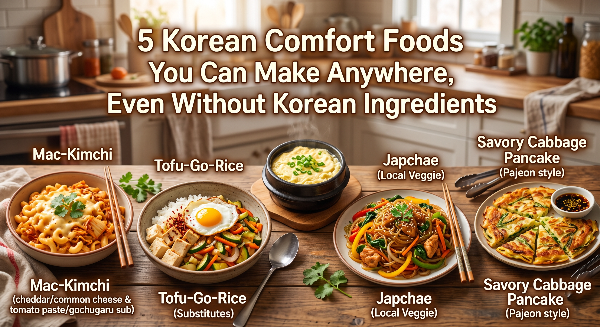
5 Korean Comfort Foods You Can Make Anywhere, Even Without Korean Ingredients
5 Korean Comfort Foods You Can Make Anywhere, Even Without Korean Ingredients
Cooking Korean Comfort Food Far From Home
There's a specific kind of homesickness that only shows up around dinnertime. For me, it wasn't missing a place — it was missing a bowl of hot kalguksu on a rainy day, or the smell of hotteok frying on a street corner. When I moved abroad, the nearest Korean grocery store was hours away, and even online delivery wasn't always reliable.
So I did what a lot of home cooks eventually do: I started improvising. Over time, through a lot of trial and error, I found ways to recreate five of Korea's most beloved comfort foods — kalguksu, sujebi, hotteok, mandu, and tteokbokki — using ingredients found in almost any regular supermarket, whether you're in the US, UK, Europe, or Africa.
This post is a collection of everything I learned. If you've been searching for "how to make kalguksu without Korean ingredients" or "Korean street food recipe with regular ingredients," this guide should save you a lot of trial and error.
1. Kalguksu (Korean Knife-Cut Noodle Soup) Without Korean Ingredients
Kalguksu is a warm, hand-cut noodle soup usually made with anchovy broth and kelp (dashima). Without Korean anchovies or kelp, I leaned on ingredients that are surprisingly close in flavor.
Ingredient Substitutes for Kalguksu
| Korean Ingredient | Easy Substitute |
|---|---|
| Dried anchovies (myeolchi) | Any small dried fish available locally, or a good-quality fish stock cube |
| Dried kelp (dashima) | A strip of nori (sushi seaweed), or simply skip it and add extra onion for sweetness |
| Korean soup soy sauce | Regular light soy sauce |
| Wheat flour noodles | Regular all-purpose flour, water, and salt — no special flour needed |
How I Made It
I made the broth by simmering a fish stock cube, a whole onion, a few garlic cloves, and a strip of nori in water for about 30 minutes, then strained it. For the noodles, I mixed flour, a pinch of salt, and water into a firm dough, rested it for 30 minutes, rolled it thin, and cut it into wide strips by hand — no noodle machine required. I dropped the noodles straight into the simmering broth along with sliced zucchini and potato, and finished it with a little soy sauce and black pepper. The result was shockingly close to the kalguksu I grew up eating.
2. Sujebi (Hand-Torn Dough Soup) With Everyday Ingredients
Sujebi is one of the easiest Korean comfort foods to recreate abroad, since it uses almost no special ingredients to begin with — just flour, water, and a good broth.
What You Need
- All-purpose flour
- Water and a pinch of salt (for the dough)
- Fish stock cube or vegetable stock (as a broth base)
- Onion, garlic, zucchini, potato
- Soy sauce, a little sesame oil if available (or skip it — it's optional)
How I Made It
I made a simple dough with flour, water, and salt, then let it rest for at least 20 minutes so it wouldn't be too tough. While it rested, I made a broth using the same method as the kalguksu above. Once the broth was simmering, I tore small, flat pieces of dough directly into the pot with my fingers — this is actually the traditional method, so no special equipment is needed at all. I let everything cook for about 10 minutes until the dough pieces floated and turned soft and chewy. This dish turned out to be the most forgiving of all five, since it barely relies on Korean-specific ingredients in the first place.
3. Hotteok (Sweet Korean Pancakes) Using Local Pantry Staples
Hotteok is a popular Korean street food — a soft, chewy pancake filled with a warm brown sugar and cinnamon filling. The dough traditionally uses a bit of glutinous rice flour, but I found a version using only regular flour that turned out nearly identical.
Ingredient Substitutes for Hotteok
| Korean Ingredient | Easy Substitute |
|---|---|
| Glutinous rice flour | Skip it, or replace a small portion with cornstarch for chewiness |
| Instant yeast | Any active dry yeast from a regular grocery store |
| Brown sugar filling | Regular brown sugar, cinnamon, and a small handful of chopped nuts (peanuts, walnuts, or sunflower seeds) |
How I Made It
I mixed flour, a spoon of sugar, a pinch of salt, warm milk, and yeast into a soft, slightly sticky dough, then let it rise for about an hour until doubled. For the filling, I combined brown sugar, cinnamon, and chopped nuts. I flattened a ball of dough, added a spoonful of filling, sealed it like a dumpling, and pan-fried it in a good amount of oil, pressing it flat with a spatula until golden brown on both sides. The molten brown sugar center when you bite into it is exactly what makes hotteok so satisfying — and it worked perfectly with regular pantry ingredients.
4. Mandu (Korean Dumplings) Without Korean-Specific Fillings
Mandu is one of the most flexible Korean comfort foods to make abroad, since the filling can be adapted almost endlessly based on what's available locally.
Ingredient Substitutes for Mandu
| Korean Ingredient | Easy Substitute |
|---|---|
| Korean glass noodles (dangmyeon) | Regular vermicelli noodles, or skip entirely |
| Napa cabbage | Regular green cabbage or even shredded lettuce, briefly blanched |
| Dumpling wrappers | Store-bought wonton or gyoza wrappers (widely available internationally), or a homemade flour-and-water dough rolled thin |
| Korean chives (buchu) | Regular chives or green onion |
How I Made It
For the filling, I mixed ground pork (or ground beef, depending on what was available), finely chopped cabbage, green onion, garlic, a beaten egg, soy sauce, and black pepper. I used store-bought wonton wrappers, since they're sold in most international supermarkets near the frozen or Asian food section. I spooned a small amount of filling into each wrapper, sealed the edges with a bit of water, and either pan-fried them for crispy mandu or steamed them for a softer version. Both turned out close enough to the real thing that I stopped missing store-bought mandu entirely.
5. Tteokbokki (Spicy Rice Cakes) — The Trickiest One, But Still Possible
Tteokbokki was the hardest of the five to recreate, mainly because of the rice cakes (tteok) themselves, which are traditionally made from a specific short-grain rice flour. Still, I found a workaround that gets impressively close.
Ingredient Substitutes for Tteokbokki
| Korean Ingredient | Easy Substitute |
|---|---|
| Korean rice cakes (tteok) | Fresh mozzarella-style rice cake substitutes are hard to replicate exactly, but thick fresh pasta (like gnocchi or thick udon-style noodles) makes a surprisingly good textural substitute |
| Gochujang (Korean chili paste) | A mix of tomato paste, chili flakes, a little sugar, and soy sauce, blended into a thick paste |
| Fish cakes (eomuk) | Skip entirely, or use thin slices of firm white fish, lightly pan-fried |
How I Made It
Since real tteok wasn't available, I used thick, fresh gnocchi as a stand-in — the chewy texture ended up working better than expected. For the sauce, I mixed tomato paste, chili flakes, a spoon of sugar, soy sauce, minced garlic, and a splash of water, then simmered it until thick and glossy. I added the gnocchi and a chopped green onion, and let everything simmer together for about 5 minutes so the "rice cakes" could soak up the spicy-sweet sauce. It wasn't 100% traditional tteokbokki, but the flavor profile — spicy, sweet, savory — was close enough to satisfy the craving completely.
General Tips for Recreating Korean Food Abroad
- Focus on flavor profile, not exact ingredients: Korean cooking often relies on a balance of savory, sweet, and spicy — as long as you nail that balance, small ingredient swaps rarely ruin the dish.
- Check the international or Asian food aisle first: Many regular supermarkets carry wonton wrappers, soy sauce, and chili flakes, even without a dedicated Korean section.
- Don't be afraid to substitute proteins: Ground pork, beef, or even tofu all work in mandu and similar dishes.
- Keep a basic pantry stocked: Soy sauce, sugar, chili flakes, garlic, and sesame oil (if available) form the base of most Korean comfort food flavors.
Frequently Asked Questions
Final Thoughts
Making Korean comfort food far from home taught me something I didn't expect: these dishes were never really about one specific ingredient. They're about warmth, patience, and a familiar flavor balance of savory, sweet, and spicy. Once I stopped worrying about finding the "exact" ingredient and focused on getting the flavor and texture close, cooking these dishes abroad stopped feeling like a compromise — it started feeling like its own kind of small victory.
If you're living somewhere without easy access to Korean ingredients, don't give up on the food you're craving. With a little creativity and a regular supermarket, kalguksu, sujebi, hotteok, mandu, and tteokbokki are all within reach — no long-distance grocery trip required.