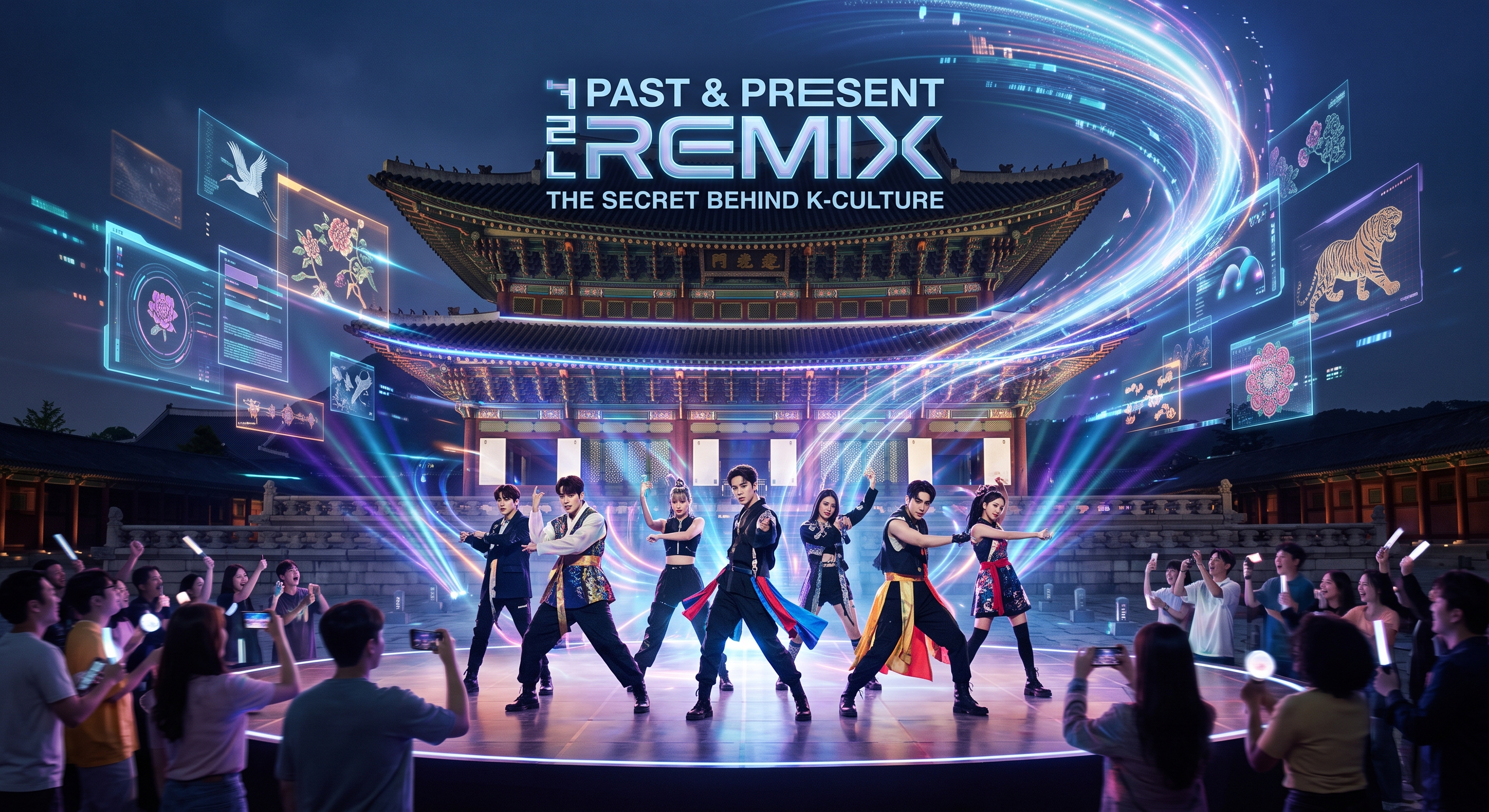
BTS. BLACKPINK. Squid Game. Parasite. At this point, most of the world has some version of K-Culture on their radar, and it's easy to chalk that up to luck, good timing, or a particularly savvy entertainment industry.
I'd argue there's more to it. Underneath the surface of this global wave sits something that took a lot longer than one lucky decade to build: thousands of years of Korean traditional culture, quietly refined generation after generation. There's an old saying that the most Korean thing is, in the end, the most universal thing — and it's hard to argue with once you look at how many traditional elements have been reworked, polished, and handed to the world in a thoroughly modern package.
So how did that actually happen? In this post, I want to dig into what makes Korean traditional culture genuinely impressive on its own terms, then walk through some of the clearest examples of that tradition being reinvented for a modern audience.
1. Where Science Meets Beauty: The Core Strengths of Korean Traditional Culture
"Old" isn't really the right word for Korean traditional culture. What's actually there is a philosophy of working with nature instead of against it, paired with scientific thinking that was genuinely ahead of its time. A few examples make the case better than any general statement could.
Hangeul: The World's Most Scientific Writing System
Linguists have a habit of gushing about Hangeul, the writing system King Sejong created in the 15th century, and once you know how it was built, it's easy to see why.
The design itself is unlike anything else. Consonants were shaped after the position of the mouth, tongue, and throat when pronouncing each sound, while the vowels were built around a simple cosmic idea — heaven (·), earth (ㅡ), and people (ㅣ). It sounds almost too elegant to be practical, but it is practical: because consonants and vowels snap together into single syllable blocks, Hangeul is unusually fast to type, whether on a keyboard or a phone's keypad, and that same block structure turns out to work well for natural language processing today. On top of that, the characters themselves — clean lines mixed with soft curves — have become a go-to visual motif in fashion and interior design.
Hanok and Hanbok: Architecture and Clothing Built to Work With Nature
Traditional Korean homes and clothing share one underlying idea: don't fight nature, work with it.
Hanok houses are traditionally sited according to baesan-imsu — mountain at the back, water in front — so the house fits the land instead of reshaping it. What really sets hanok apart, though, is that a single house typically combines ondol, an underfloor heating system found nowhere else in the world, with the open, breezy daecheong veranda. The result is a home that stays warm through the winter and cool in summer without much outside help — which is basically what "eco-friendly architecture" is supposed to mean.
Hanbok works on a similar logic. Western clothing is cut and tailored to the body's curves; hanbok is cut flat, and the curves come later, formed naturally by the fabric as it's worn. The loose, generous cut catches air as the wearer moves, and the deep, natural dye colors shift and flow with every step — very different from the fitted, structured look most people expect from formalwear.
Hanji and Onggi: Materials That Somehow Outlast Modern Alternatives
There's an old phrase in Korean — jicheonnyeon gyeonobaek — that translates roughly to "paper lasts a thousand years, silk lasts five hundred." It's referring to hanji, traditional paper made from mulberry bark, and it's not really an exaggeration. Where Western paper is often acidic and breaks down over time, hanji's mulberry fibers form a natural lattice that breathes, absorbs moisture well, and barely discolors even after centuries. It's a well-known fact in conservation circles that the Vatican has used Korean hanji to restore some of its own ancient manuscripts.
Onggi, traditional earthenware storage pots, do something similarly clever. When the clay is fired, tiny grains of sand leave behind microscopic pores — small enough to let air through but not water. That's exactly what fermentation needs, which is why food stored in onggi stays fresh instead of spoiling. People often call it "the breathing vessel," and honestly, that's a pretty accurate nickname.
2. Old Wisdom, New Expression: Tradition Meeting Modernity
None of this would matter much if Korean tradition had just stayed behind museum glass. What actually happened is that creators took these old forms and fused them with modern lifestyles and a genuinely global sensibility — and that's really where K-Culture as we know it comes from.
Modernized Hanbok: From Wedding Closet to Streetwear
Not long ago, hanbok was something you wore to a holiday gathering or a wedding and then put away. Now it's streetwear, and young people around the world seem to think it's genuinely cool.
A big turning point was BLACKPINK's "How You Like That" music video, which has racked up hundreds of millions of views. The group performed in reworked versions of traditional dopo robes and cheollik — historically a Joseon-era military uniform — reimagined as crop tops and shorts for a high-energy dance number. For a lot of viewers outside Korea, that was the moment hanbok stopped looking like a costume and started looking like fashion.
At the same time, everyday hanbok brands have been quietly building a real market. They keep the traditional collar and tie details but swap in zippers, pockets, and washable denim or linen — clothes you could genuinely wear to work, not just to a festival.
Hanok-Style Minimalism, Now a Global Interior Design Trend
Nature-inspired minimalism has been a major interior design trend across Europe and North America for a while now, and it turns out hanok already figured out a lot of it centuries ago — the flexible use of space, the restraint, the quiet.
Old hanok houses in neighborhoods like Samcheong-dong, Ikseon-dong, and Bukchon have been converted into cafés and boutique stays, often mixing in floor-to-ceiling glass, modern lighting, and exposed concrete. Somehow a Western sofa doesn't look out of place next to a traditional wooden beam — if anything, the contrast between the warm wood and cool metal furniture is exactly what makes these spaces feel so current.
There's also the idea of chagyeong, or "borrowed scenery" — using a window not just to let in light, but to frame the landscape outside like a living painting. Modern apartment and villa designers have picked this idea up too, and it's a small thing that seems to genuinely calm people down in the middle of a busy city.
Traditional Art, Reissued as Pop Culture Merchandise
The gift shop at the National Museum of Korea has, somewhat improbably, become a place where people line up before opening. The reason is simple: traditional artifacts have been redone with a playful, kitschy, very buyable sensibility.
Take the Pensive Bodhisattva — a solemn national treasure that used to sit quietly behind glass, treated with religious reverence. Now it also exists as a pastel pink, mint, or purple miniature figurine that people buy for their bookshelves. The traditional mother-of-pearl inlay technique, meanwhile, has shown up on tumblers, phone cases, and earbud cases, catching light in a way that's turned it into a genuine collector's item for younger buyers.
Then there's the music side of things. In the Korea Tourism Organization's Feel the Rhythm of Korea video series, a pansori passage from the story of the rabbit and the turtle got reworked into a strange, addictive psychedelic pop-rock track, paired with equally strange modern dance. The video ended up with hundreds of millions of views on YouTube — proof, if anyone needed it, that traditional Korean music can be every bit as "hip" as anything coming out of a modern studio.
3. Why It Resonates: Authenticity Plus Scalability
So why does traditional Korean culture hit this hard once it's been reinterpreted for a modern audience? A few reasons keep coming up.
| Element | What it looks like | Why it works |
|---|---|---|
| Nature-friendly values | A philosophy built around following nature rather than overriding it | Lines up naturally with today's global push toward sustainability |
| Distinctive storytelling | Deep emotional threads around filial devotion, jeong (a sense of warmth and connection), humor, and han (a particularly Korean kind of sorrow) | Goes beyond looking good — it actually moves people |
| Digital adaptability | Traditional design that's modular and intuitive by nature | Slots easily into short-form video, gaming, and virtual spaces |
There's also a simpler explanation underneath all of this: people were tired of a pop culture landscape that felt homogenized and heavily Western. K-Culture showed up feeling exotic enough to be interesting, but warm and human enough underneath to actually connect with people. None of that would have worked without a solid foundation of tradition sitting underneath it.
4. Where This Goes From Here
Bong Joon-ho, accepting his Oscar for Parasite, quoted Martin Scorsese: "The most personal is the most creative." It's not a huge leap to apply that same idea to culture as a whole — the most traditional things, done well, end up being the most universal.
The real strength of Korean traditional culture isn't that it's been perfectly preserved in some untouched state. It's that it keeps moving — merging with new technology, new formats, new audiences, generation after generation. The more people understand what past generations actually built, scientifically and artistically, the more room there is to keep reinterpreting it for whatever comes next. That's what turns a trend into something closer to a classic.
It'll be interesting to see what happens next with ondol, fermented foods, traditional crafts, and all the other pieces of Korean heritage that haven't had their moment yet. In the meantime, it might be worth taking a second look at the traditional details already sitting quietly in your own everyday life.